Air India Pilots raise alarm after Ahmedabad Crash
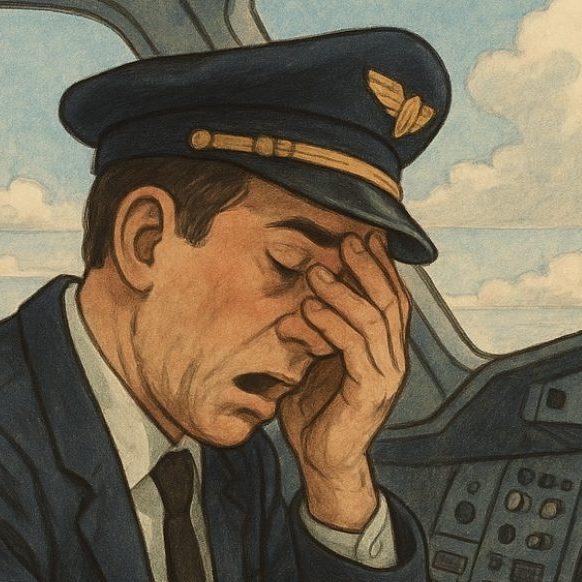
Pilots fly them but they are not machines
The Crash And The Whispers:
Trying Hard to Soar on Broken Wings
Following the June 12 crash of Air India flight AI-171, Ahmedabad–London service that went down less than a minute after take off, killing 260 people, pilots across the airline are sounding an alarm that has long gone unheard: fatigue.
There is an uneasy disquiet , resentment, few silent screams – Air India pilots, today, are trying hard to soar on broken wings.
While the official investigation into the crash is still underway, many within Air India point to systemic fatigue and operational stress brewing for some time within the pilot community. “It must be fatigue,” one young pilot said as a first reaction upon hearing news of the fatal crash. For many others, the crash was a chilling culmination of what many feared.
Seasoned pilots said the same thing, albeit with more situational gravity. “Every time a senior pilot came out of a meeting with management, the drift was, there will be a hull loss at this airline.” Prophetic. The AI-171 disaster marked the first-ever hull loss of the Boeing 787 Dreamliner since its commercial debut in 2011.
“It’s continuous testing of human performance, and a constant state of stress, fatigue and of being tired.” Why are Air India pilots so worried? Why are they feeling they are pushed to the brink, their concerns falling on deaf ears? Why few of Air India pilots collapsed before accepting or after undertaking flights?
Why are they declaring a ‘Fatigue Mayday?’
The Tata Transition : From Airline To Alogrithm- Performance tracking devices, merit-demerits – pilots flying even when unwell
“We are not IT professionals, but we are pushed to function like them”
Since the Tata Group assumed control of Air India in 2022, pilots feel the airline has undergone a significant cultural transformation—one that has led to confusion, stress, and a steep increase in emotional fatigue. The merger of multiple airline entities – Air India, Vistara, AirAsia India and Air India Express – has created a complex operational environment with contrasting standards, expectations, and work culture and reporting systems.
Internally, pilots now refer to this as “Tata style” of functioning -corporate hierarchy, inflexible in structure, TCS pumped tab or digital systems, a culture that is completely at odds with the legacy systems many pilots were used to.
There are performance tracking applications, and a new data-driven work culture. Pilots are now assessed under a merit-demerit system across five performance categories, with bonuses linked to internal scores.
“We’re not IT professionals, but we’re being pushed to function like them,” said one pilot. “Everything is about data and points. There’s no space left for human interaction. There is no one to talk to.”
Younger pilots, especially those managing pilot training debt or EMIs, report for flying while unwell or exhausted out of fear of point deductions resulting in reduced pay. “The senior pilots still have the confidence to speak up,” said one insider. “The juniors are simply overwhelmed.”
Bonuses are now tied to these internal scores, and some pilots worry the metrics don’t account for the complex human dimensions of their work.
Flight Duty Time Limits : Pushed to the Edge : “Unethical Rosters”
A week of eight days
“We need to understand if 12 June was deliberate action, what triggered it, policy wise, from Tatas.”
On July 23, the civil aviation regulator, DGCA, issued a show cause notice addressed to the Director of Flight Operations at Air India, Pankul Mathur.
The notice highlighted three instances of violations related to flight duty periods and weekly rest period requirements.
“These violations reflect serious deficiencies in crew scheduling, operational planning, and regulatory oversight within the flight operations function.” The DGCA held Mathur accountable, stating that he had failed to ensure compliance with the Civil Aviation Requirements as outlined in the regulations.
A similar notice was also sent to the Director of Cabin Safety, pointing to comparable violations.
Barely ten days after the Ahmedabad crash, the DGCA issued a show cause notice to Air India for violations of flight duty timings. In a sterner and more punitive measure, the regulator directed the airline to remove three of its crew scheduling officials, including the head of rostering, as they were identified as repeat offenders. But after a month of that directive, sources say, “they are being quietly brought back.”
“They have removed transparency from the system, lot of manipulation and those who have access can get the work done,” a senior pilot laments.
A rostering official was boasting to crew, “rostering is in control of their lives and they can make them dance to their tunes.” Nasty, to say the least.
The DGCA permits Indian airlines to schedule a “weekly off” after 168 hours of duty, as per the Civil Aviation Requirements – a rule Air India now stretches to its last minute limit. So, essentially a ‘weekly’ off for the pilots comes on the eighth day! “It’s legal, technically compliant but barely,” said a pilot. “No other country stretches pilot resources like this.”
So while the FDTL says 168 hrs should not exceed between end of one weekly rest to start of another, they start 168 hours from start of duty – “That is a violation,” pilots say.
Following these extended rosters, pilots often receive only a 36-hour rest. Many report returning to duty before their circadian rhythm has stabilized. “I don’t feel physically balanced when I get back in the cockpit,” one pilot admitted.
Important thing to note here is , “rest for the pilots should not only be 48 hours, it needs to be two full calendar days,” this is where the fatigue sets in, as Air India is not being judicious by clocking 168 hours from the time of reporting for the flight, pilots add.
While rest periods for pilots flying on international routes were marginally increased following the crash and longer flying times due to air space closures, domestic schedules remain tightly packed, unforgiving and beyond human stamina.
Introduction of largely ‘flexible rosters’ as opposed to fixed rosters and random flying patters is also challenging pilots at Air India who are more used to fixed rosters. This has killed predictability resulting in erosion of stability and basic work-life balance. Pilot availability is determined by operational needs, pilots informed of changes sometimes just hours before they are supposed to fly. “It’s like scheduling daily assignments. You can’t plan your life anymore, there is no recovery time.”
Also, the change in flying patterns for pilots on narrow-body fleet has been particulary acute. “The only rule they follow is WOCL, said a narrow-body pilot, referring to the Window of Circadian Low- between 2 am and 6 am – a time universally acknowledged to carry the highest fatigue risk.
But even those are sacrificed. “Short haul international routes are frequently scheduled for departures during WOCL. At least IndiGo (the market leader low cost carrier) gives a WOCL allowance per hour, nobody is thinking of it here.”
For random patterns, the curt response of management, “ It works better for us (airline), that’s what our research says, so yes, these patterns will be there as its profitable for the company.”
Fatigued? “Let us decide that for you“
“Pilots are being stripped of every shred of dignity layer by layer, systematically.”
The single most challenging and detrimental change for pilots has been the fatigue reporting. Fatigue reports are routed through HR, not operations. Its termed as “HR takeover.” If a pilot files for fatigue, HR checks select data points and determines whether the individual is fit to fly or report fatigue. “If they say you’re okay, you’re expected to report for duty, irrespective of how one is feeling.” Not to mention the sword of demerits always dangling.
Pilots are avoiding reporting fatigue as the scrutiny feels demeaning and they are reluctant to engage with individuals where there is trust deficit. “This all is done to uphold a fear psychosis at work.”
After the takeover by Tatas, during the initial phase of new roster introduction, pilots together had approached the HR and they were heard. But this is not the case anymore. There is a sense that pilots want to collectively address the issue again. “Your licence, your life,” the sentiment is echoing strongly.
The rollout of a new crew management system—CAE—has further frustrated Air India pilots. Unlike the previous ARMS platform, CAE has been described as “unfriendly,” with limited access to critical flight records and compliance data. “We can’t track our own takeoffs, landings, or licence expiry dates retrospectively,” said a pilot.
Too many forms to fill, some take up hours, a very rigid bureaucratic set-up is creeping in, “Unless you raise a ticket or send an email, nothing gets resolved.” Believe it or not, there are forms to be filled if a pilot needs wing replacement, with the old / broken wing to be submitted to respective department! “Got fatigued looking at the fatigue form.”
Flying Time vs Duty Hours: The Hidden Disparity
“Pilots are working more, getting paid less , and there’s still no pay parity.”
After the Tata takeover, HR reportedly raised concerns that cockpit crew were being compensated for the entire month despite flying only 18–20 days. They questioned whether this work input justified full monthly pay. What’s often overlooked is that a pilot’s salary is determined by flying hours—not duty hours. In the initial phase, there was a strong pitch to assign pilots to airport standby duties and extract more from available manpower. Operations eventually pushed back, and the proposal was shelved.
But now, with automated rosters in place, pilots feel it’s time to revisit the conversation. They demand a clear audit—has duty time increased despite similar flying hours? With longer reporting windows, frequent deadheading, and unpredictable layovers, pilots are clocking far more duty hours than compensated for. A pilot may fly 12–13 hours but spend over 50 hours on duty—yet only the flying time gets paid.
“It’s only logical,” said a pilot, “that if you’ve moved to automated rostering, payroll too must evolve. We should be compensated for duty hours, not just flight time.”
Pilots feel this is a basic hygiene factor being ignored. With no mechanism to address this growing disparity, fatigue is rising—and so is frustration.
What’s compounding the unrest is the stark pay parity gap between fleets. While some international carriers offer equal pay scales across narrow and widebody fleets, the same isn’t true in India. Management pilots and widebody commanders receive a fixed salary based on 70 flying hours, plus an additional ₹75,000 as widebody allowance. Narrow-body pilots, often stuck at 40 hours with no pay parity across fleets.
With few A320 representatives in top management, narrow-body pilots feel the airline’s workhorse fleet is being short changed- both in recognition and remuneration. As long as no one sits across the table to acknowledge and address this brewing discontent, the divide will only deepen.
Leave Cuts and Standby Stress
“Basic hygiene factors like leave, predictability and family travel are being stripped away.”
Air India has quietly slashed sick leave—from 21 days to 12—and casual leave from 10 to just six days. At the same time, pilots say standby duties have become increasingly stressful, with vague instructions and wide availability windows.
A pilot rostered for a 9-to-5 standby can be expected to be available from as early as 5 a.m. to as late as 9 p.m., with last-minute changes communicated at any time. “If you miss a notification because of an app glitch, the blame falls on you—not on rostering,” said one captain.
Long waiting hours at domestic airports for narrowbody pilots, changes in travel policies, and the removal of free or discounted standby travel for immediate family—once essential to maintaining work-life balance—are basic hygiene factors that are now being ignored, if not actively shunned, in the current system.
Conclusion: Trust, Safety, and the Human Cost
Air India declined to comment for this story, citing a company policy of not engaging with independent journalists. Informally, the airline maintained that support mechanisms exist for managing pilot stress and mental health—mentioning access to aviation psychologists and internal peer groups.
However, there is no clear guidance on what happens when a pilot actively discloses stress or seeks help from an external mental health professional. Is such disclosure supported or penalized? That remains unanswered.
“If they don’t take our fatigue declarations at face value, how can we expect real empathy for mental health issues?” Air India pilot questions.
This absence of clarity has contributed to growing mistrust. Pilots speak of a culture of top-down decisions, stripped of the human element. Even in the wake of the Ahmedabad crash, when a fellow pilot lost his life, sources say there was resistance around granting leave to attend the funeral. The silence is telling.
Yet, accountability does not rest with the airline alone.
The Directorate General of Civil Aviation (DGCA)—the aviation regulator—is tasked with ensuring airlines operate within safe, humane limits. While Air India has voluntarily disclosed violations of Flight Duty Time Limitations (FDTL), the findings of the regulator’s own audits remain opaque.
“The regulator gives exemptions for ultra long-haul flights—but what’s the point if pilots don’t get enough rest to function safely?”
Pilots argue that rest is not optional. It is a requirement for safety. And if the regulator fails to enforce those boundaries, the system itself is compromised.
“Air India’s job is to turn a profit. The DGCA’s job is to ensure safe operations. If the regulator fails, who is left to protect us?” Asks a prominent activist who has fought the system for pilot rest and stretched FDTL.
For operations to be truly safe and sustainable, Air India management must engage with its crew meaningfullythe table and acknowledging what’s broken.
Without a functional, transparent, and empathetic system to address fatigue, mental health, and operational stress, the cracks will only deepen. And in aviation, those cracks carry real risk.
ENDS
DISCLAIMER:
The story specifically is talking about Air India pilots. This in no way means that pilots at other airlines are better off. The pilots flying for the market leader IndiGo have similar challenges. But the story is specifically in context of Air India pilots, as there is urgency , change in ownership and also a fatal crash impacting the hygiene and working conditions putting pressure on pilots.





 Planes. Talks. Travels.